Translate

Showing posts with label Read me. Show all posts

9/07/2018

Read Me: Some Notice for Enjoyment at Public Bathhouse "Sento"


Hi everyone who want to go or is going to Japan,

Have you had a experience to take in a hot spring? Did you like it? As you may know, There are lots of hot spring spots in a town in Japan. In addition to them, There are  lots of public bathhouses, are called "Sento" or "Super Sento" in Japanese. 
- "Sento(銭湯)": Cheaper bathing fee from JPY400 to 500 depending on area. 
- "Super Sento(スーパー銭湯)": Bathing fee over around JPY700 and many types of bath in many cases.
At this time, I want to let you know some notices to not bother others who come  there. Those notices are not difficult or complicated requirements. And then, I will show you some things what I want you to know for enjoyment of Japanese public hot spring and bathhouse.
Building of Japanese bathhouse "Sento"
I guess that you would see such a poster as below at public bathhouse in Japan. The poster describes some notices to take a bath there. (Please follow the notices even if you don't see any poster like this.)


  1. Taking off your underwear before getting in a bath/bathtub: People is supposed to take a bath naked. None of Japanese does it.
  2. Washing yourself well before getting in a bath/bathtub: To keep water in a both clean. 
  3. Keeping your towel out of bath/bathtub: To keep water in a both clean.
  4. Turning on a shower while you need it and turn it off when you don't use it: To save energy and for eco-friendly.
     
  5. Washing your clothes is prohibited: Use too much space at washing area and too much water.
     
  6. Wiping water off your body before going to a dressing area: To keep a dressing area clean, not to soak wet the floor of the area. Some of Japanese do it, unfortunately.
Then, there are other posters for that like the following.

And other things what I want you to know are the followings.

  1. You many want to take 2 towels (bath and face towels) and some bath goods such as soap, shampoo and others when you go to a public hot spring or bathhouse in a town, because those goods are not provided for you for free of charge there.

  2. Pay attention to which room is for men or women. In most case, navy is for men, and red is for women. "ゆ"="Yu" on the picture mean hot water. 

  3. Taking your shoes off before get into a dressing area. There are shoe boxes with a key at the entrance of a bathhouse. (Normal type key <Left> or wood type key <Right>)
    One type of shoe box
    A Wooden Key

    A Common Metal Key, as you know
  4. Enjoy a beautiful artwork of something related to Japan on the wall of bath/bathtub.
    Beautiful artwork of Mt. Fuji on the wall of bath/bathtub
  5. Cool your body with a bottle of cold milk or coffer-flavored milk. I have one of them at each time I go to a bathhouse. almost all bathhouses provide them and the tool to open paper lid of them. I love both of them, but I prefer coffee-flavored milk, if anything. Please try them!!
    A bottle of milk
    A bottle of coffer-flavored milk

    A tool to open a paper lid 
I think that taking a bath is one of Japanese culture. So I want you to have a experience to do that. You must enjoy and feel relaxed!! There are really lots of bathhouses in Japan, especially in Tokyo. You can google "銭湯"="sento" and find some bathhouses out nearby. Search them and experience one of Japanese cultures in Japan!

Enjoy your trip in Japan! And see you in the next article of the blog!! 
"The ordinary for Japanese" must work to spice up your trip! 

9/04/2018

Read Me: Long Holiday Seasons in Japan That You May Want to Avoid Going to Japan


Hi everyone who want to go or is going to Japan,

Do you know some long holiday seasons in Japan? In the season, main cities, such as Tokyo, Kyoto and Osaka, are awfully crowded with people!! Hmm, you want to tell me that those cities are always crowded with them? Yes! You are right!! You are very familiar with Japan. Those get more crowded at weekend than on weekdays. However, the long holiday seasons I will explain are extremely crowded. It is exactly chaos!! So I would like you to know the seasons and plan for Japan travel, and you don't need to worry about them so much! Fortunately, each Japanese long holiday season doesn't last for over a month. It lasts for fewer than 10 days each. You still have lots of options for travel in Japan!!
There are 3 periods in a year that you may want to avoid going to Japan. Some days of each period are public holidays, and most of Japanese have long vacation in the each season.
  1. "Golden Week": From around the end of April until around the end of the 1st week of May.
  2. "Obon" holiday: From around the end of the 2nd week of August until around the end of the 3rd week of August.
  3. New year's holiday called as "Sho-gatu": From around the end of the year until around the end of 1st week of January.
1. "Golden Week": 3 Japanese public holidays. 3rd of May as Constitution day, 4th of May as Greenery day and 5th of May as Children's day. Most of Japanese take some days off before and after the public holidays in between weekends. You can maximize your vacation time to 9 days. You can see lots of gigantic carp streamer anywhere. Those are colourful and photogenic!!

Gigantic carp streamer, "Koinobori" hung up for celebrating Children's day 
2. "Obon" holiday: The period from 13th of August until 16th of August is called "Obon" in general. "Obon" is one of traditional custom in Japan. We believe the souls of ancestors come back to our world from the underworld and stay home they lived during the "Obon" period. Many of companies is closed during the period, and many of Japanese take some days off before and after the period holidays in between weekends. Their vacation time usually be maximized to 9 days. They go to their parent's home, spend good time with their parents and visit the graves of their ancestors. Brilliant thing about "Obon" period is that there are lots of fireworks events in many parts of Japan.


3. New year's holiday, called as "Sho-gatu": Most of Japanese take long New year's vacation from around 29th of December until the end of the 1st week of January. I don't think that people who live in other counties takes such long vacation at New Year's. Most of Company is closed from 30th of December until 3rd of January in general, and Most of retail store and restaurant is closed 31st of December until 2nd of January because of short of hands. Good thing in the period are that you can go to a shrine or temple at midnight on New year's Eve ans stay there until New year's day. There is lots of people there, and many of famous shrines and temples are open. Then, you may see some lady or girl wearing "Kimono" easily on somewhere in a shrine or temple in the 1st week of January.


Did you get all of the 3 holiday seasons in Japan? I show some good things during each of the period to encourage you, but as my opinion, you may want to avoid going to Japan during those seasons if you can do that. You must wait in the longest queue ever, get involved in a heavy traffic jam on a road and difficult to find the place where you can park, book a tickets for an airplane or train "Shinkansen bullet train", or a hotel. Moreover, the price of them would be more expensive than usual.


If you want to see things or have experiences in the holiday seasons such as above I wrote, you should go to Japan then!! What you want to do is the most important for you. I hope that you just spent your money and time efficiently!!

Enjoy your trip in Japan! And see you in the next article of the blog!! 
"The ordinary for Japanese" must work to spice up your trip! 

P.S. Most of office workers take a train on the following time periods on weekdays, so almost all of trains/subways/metros in Tokyo or Osaka are overcrowded. Take care of them!!


  • In the morning: Around from 7 am to 8:30 am
  • In the evening: Around 17 to 18:30

8/29/2018

Read Me: For Venturing Local Restaurants in Japan


Hi everyone who want to go or is going to Japan,

I think that One of the pleasures of travel is eating delicious local foods, and you must want to try some Japanese food when traveling in Japan. I'm going to introduce some foods which Japanese have usually to you in the blog. But before that, I'm telling you basic things about local restaurants in Japan. Such information would help you to understand Japanese local restaurants and encourage to venture Japanese local restaurants!!


1. Order and Payment

There are some way to order meal and pay the bill/check, and I guess that you are not familiar with one of them.

  • Pay at a vending machine and order (Unique way in Japan): There is a vending machine on the inside or outside of a restaurant. You put in some money and buy the ticket for your desired meal at the vending machine. Please don't forget to take the change!! You pass the ticket to a staff to order your meal after taking a seat.  
  • Pick up some foods on shelves and paying: Many varieties of meals are on shelves on the inside of a restaurant. First of all, you take a tray somewhere at the restaurant. You pick your desired meals up from the shelves, pay the bill for the meal at register and take a seat.
  • Order and paying at resister before eating: Normal way at fast food shops like McDonald's in the world.
  • Paying after eating: Majority way at restaurants in the world.

2. Drinking Water

As I said on the article in the blog, tap water in Japan is potable. Many of local restaurants provide some iced/hot water, sometimes barley tea or green tea for free of charge. 
<Japanese lesson: Cold water="冷水", Hot water="温水", Barley tea="麦茶" and Green tea="緑茶">

    • Be served a glass of water, and you ask a stuff another one each time. <Japanese Lesson: "Mizu"=Cold water, "Oyu"=hot water, "Ocha"=tea and "Kudasai"=Can I have>
    • Be served a glass of water and a water pitcher.
       
    • Be served a glass of water, and you refill a glass with a water pitcher nearby.
    • Be served a glass of water, and you refill a glass with a water server.

    3. A Wet Towel (Oshibori)

    I guess that all of local restaurants in Japan provide a wet towel for you to wipe your hands clean for free of charge. Some of them provide a wet cloth towel, and the others provide a wet paper towel. I prefer the feeling of wet cloth towel. Some of Japanese men, especially over middle-aged men, often wipe their face with the cold cloth wet towel (in summer)/hot cloth wet towel (in winter). As a matter of fact, it is said that is not good manner. However, if you are interested in it, please try it. You may feel so good!

    • A wet cloth towel (cold or hot).
       
    • A wet paper towel (cold).
    4. Chopsticks (Hashi)

    As you may know, Japanese often use a pair of chopsticks and sometimes use fork, spoon or knife differently to eat a meal depending on menu what they have. 
    Each local restaurants have a different way to provide chopsticks to customers, and most of restaurant provide throwaway wooden chopsticks. Don't forget to split apart a pair of chopsticks!!

    <If you are not familiar with chopsticks, you can ask a staff to borrow fork, knife and spoon.>

    • Put many pairs of chopsticks in a chopstick holder.
    • Bring a pair of chopsticks with meal. <Japanese Lesson in case you dropped your chopsticks: "Ohashi"=chopsticks and "Kudasai"=Can I have.>
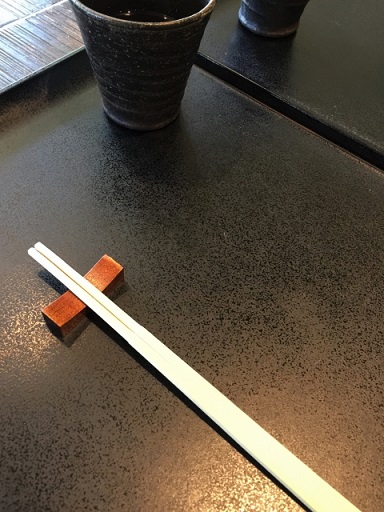
    • Provide a pair of chopsticks for each person when you sit at a table.

    I think that each of above topics are categorized enough and roughly, and every local restaurant combines them. So, you can enjoy finding what  combination a restaurant has. Additionally, Please don't worry about how you order, get some water and a pair of chopsticks, whether that wet towel is for free of charge.

    Enjoy your trip in Japan! And see you in the next article of the blog!! 

    "The ordinary for Japanese" must work to spice up your trip! 

    KFC (Kentucky Fried Chicken ケンタッキーフライドチキン) Biscuit With Maple Syrup

    Hi everyone who want to go or is going to Japan, I'm sure that most of you know KFC fried chicken chain ,because KFC i...